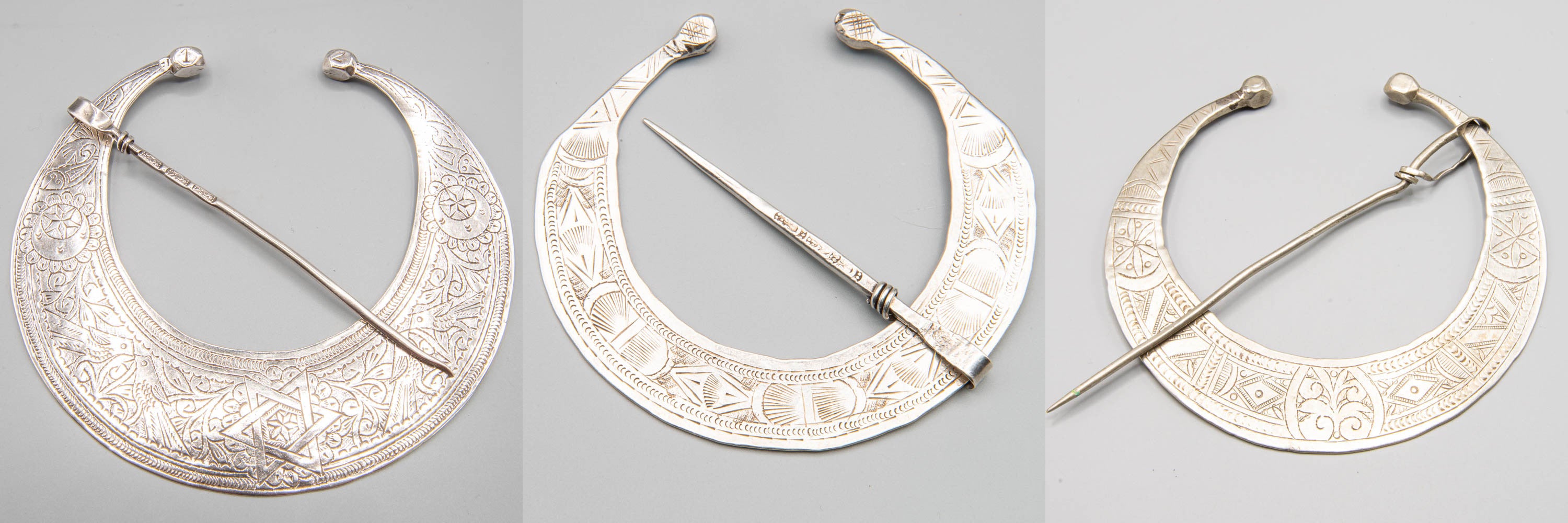
Article: How to Identify Antique Moroccan Silver Jewelry
How to Identify Antique Moroccan Silver Jewelry
Antique Moroccan silver jewelry is remarkably varied. Bracelets, fibulae, earrings, pendants and amulets were made for different communities and regions, and pieces that look similar at first glance can differ significantly in age, construction and cultural origin.
Start with construction, not decoration
The safest starting point is to look at how a piece was made. Cast forms, forged sheet, twisted wire, applied granulation, engraved decoration and hinged or pinned closures all provide clues. Hand-finishing, irregularities and wear can be useful indicators, but none of these features alone proves age.
Study regional form
Moroccan jewelry traditions vary greatly between the Anti-Atlas, the High Atlas, Saharan regions and northern areas. Fibula shapes, bracelet profiles and decorative vocabularies may point toward particular regions or communities. Because objects travelled through marriage, trade and resale, a regional attribution should be treated as stronger when several features agree.
Arkandis groups relevant pieces in the Berber jewelry collection and the brooches and fibulae collection.
Patina and wear matter
Older silver usually develops surface wear consistent with use: softened edges, polishing on raised areas, darker oxidation in recesses and small knocks or repairs. Artificial ageing can imitate colour, so patina should be read together with construction and wear rather than used as a stand-alone test.
Hallmarks can help, but they are not the whole story
Some Moroccan silver pieces carry control marks, workshop marks or later assay marks, while many traditional rural pieces are unmarked. A hallmark can help establish that a piece passed through a particular control system, but the absence of a mark does not automatically mean a piece is recent or inauthentic.
Materials should be identified cautiously
Traditional Moroccan jewelry may combine silver with coral, amber, glass, shell, enamel and other materials. Old beads were often reused, and later repairs or replacements are common. For that reason, it is often more accurate to describe a necklace or bracelet as an old composition containing older elements than to assume every component dates from the same period.
Use documentary comparisons
Museum collections, historic photographs, early ethnographic publications and specialist books are especially valuable when identifying an unfamiliar form. A good comparison should match more than a general silhouette: construction, scale, decorative details, geographic context and function should also be considered.
Distinguish certainty from attribution
Responsible cataloguing means separating what can be observed from what is inferred. Material, dimensions and construction can often be stated directly. Region, community and date may instead need wording such as “attributed to”, “probably”, or “consistent with”. This distinction is important for collectors and is part of the way Arkandis researches each object.
Arkandis specialises in antique and vintage ethnographic jewelry and describes each piece as accurately as the available evidence allows, preserving original patina and signs of age whenever possible.